[Anchor]
Four years ago, a sudden downpour led to the tragic deaths of three family members in a semi-basement home in Sillim-dong, Seoul. Starting today, a new urban flood forecasting system, developed in the wake of that incident, has officially begun operations.
Climate and Environment Correspondent Jang Se-man reports on what has changed.
[Reporter]
On August 8, 2022, Seoul was struck by a torrential downpour, with rainfall reaching up to 141 millimeters per hour.
A woman in her 40s, her sister, and her young daughter, who lived in a semi-basement home in Sillim-dong, were unable to escape the rising floodwaters and lost their lives.
While a flood forecasting system existed at the time, it focused primarily on river levee overflows, making it ineffective for predicting flooding in urban residential areas.
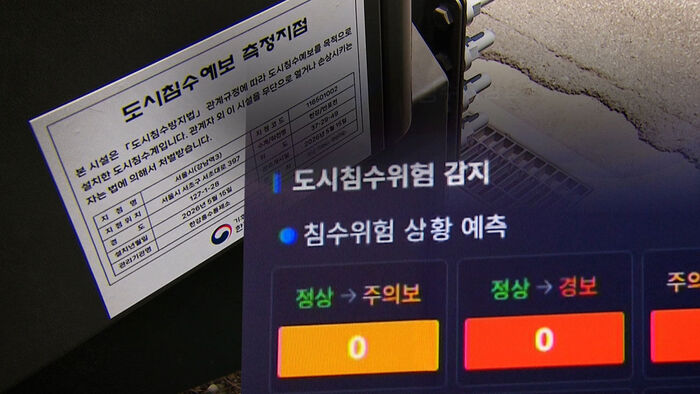
Following the enactment of the Urban Flood Prevention Act, the government established a new urban flood forecasting system, which went into operation today (June 19).
We simulated the situation in Sillim-dong during the 2022 flood using this new system.
Around 6:00 a.m. that day, data on rainfall and Han River water levels showed no significant issues. However, as the rain intensified, a flood advisory was issued for the area before 1:00 p.m.
The fatal incident occurred around 8:30 p.m., meaning the risk of flooding could have been identified seven hours in advance.
[Cha Jun-ho / Researcher, Han River Flood Control Office: Around 12:50 p.m., the system could have determined that a flood advisory was necessary. It appears we could have provided warnings at least several hours ahead of time.]
Predicting urban flooding requires understanding underground conditions, such as clogged sewage pipes, and it is now possible to monitor these conditions.
This is because the system is linked to nearly 400 water level sensors installed in sewage pipes across six districts, including Seocho, Gangnam, and Gwanak in Seoul.
Real-time data on sewage water levels is transmitted to a control center, and when a flood advisory or warning is issued, text alerts are sent to residents in the affected areas.
[Kim Tae-hyung / Researcher, Han River Flood Control Office: We are also installing additional sensors to monitor conditions such as rain gutter blockages to better understand the situation.]
The government plans to analyze the results from the six districts in Seoul and establish a roadmap to expand the system nationwide by the end of the year.
Reported by Jang Se-man | Video by Lee Byung-ju | Video Editing by Kim Yoon-sung
※ Please note: This article was translated by AI and may contain errors.
Preventing a Repeat of the '4-Year-Old Tragedy': New Urban Flood Forecasting System Launches
By Jang Se-man | Jun 19, 2026